ROUGH RAINBOW
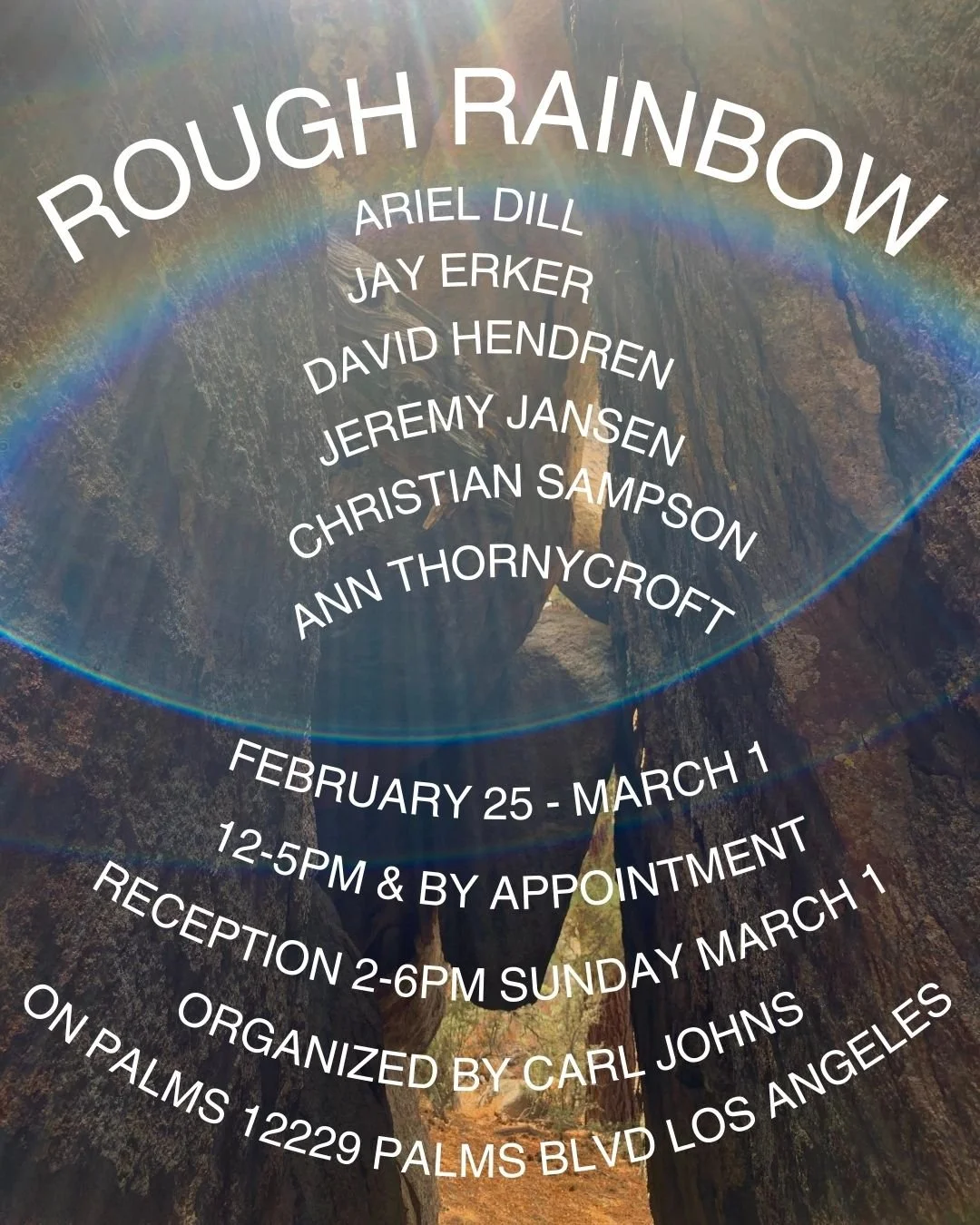
February 25 - March 1, 2026
On Palms, 12229 Palms Blvd, Los Angeles
Ariel Dill - Jay Erker - David Hendren - Jeremy Jansen - Christian Sampson - Ann Thornycroft
Organized by Carl Johns
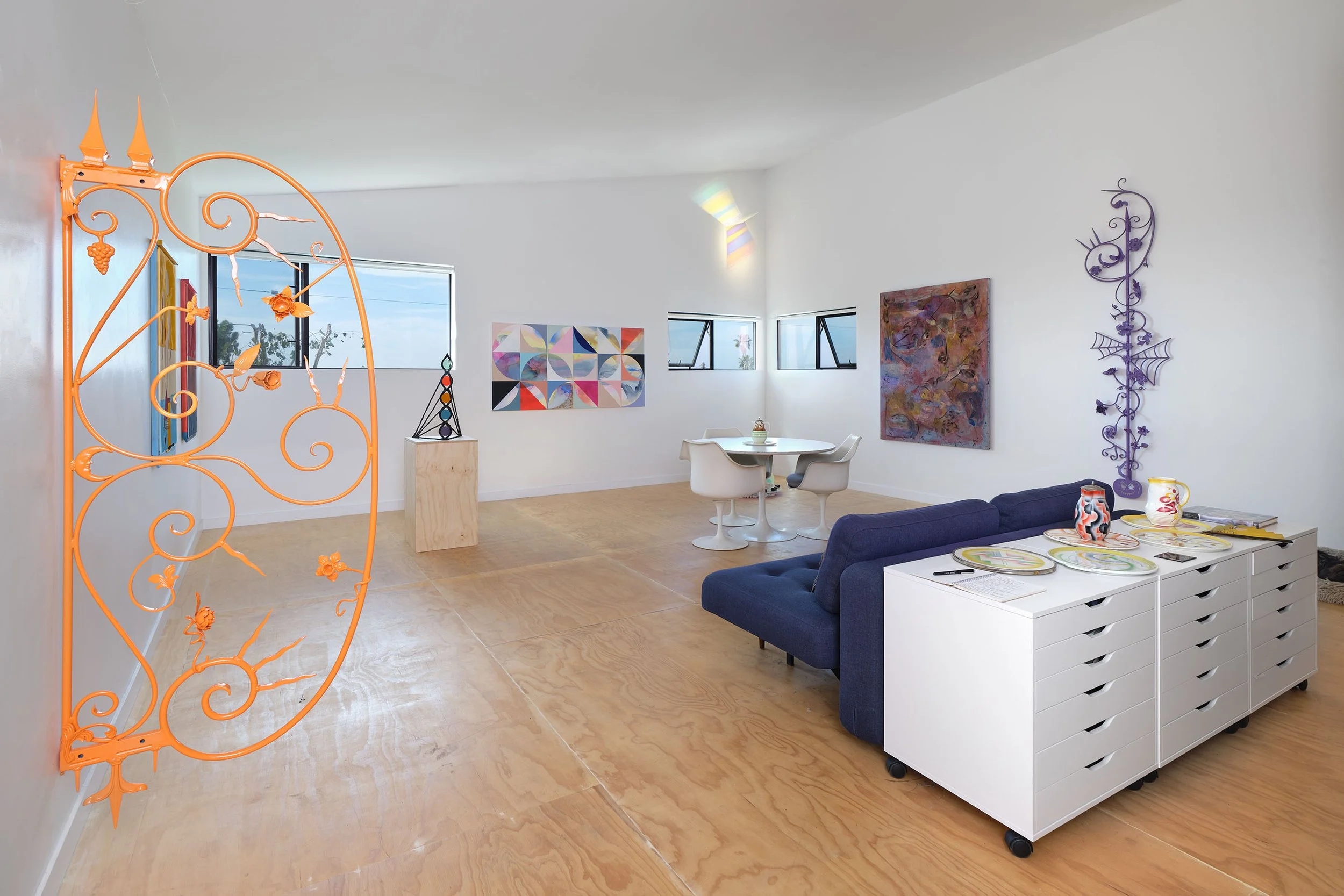
Rough Rainbow brings together nine works by Los Angeles–based artists Ariel Dill, Jay Erker, David Hendren, Jeremy Jansen, Christian Sampson, and Ann Thornycroft in the first public exhibition at On Palms, a multi-use art compound in Mar Vista, less than a mile from the concurrent Frieze LA art fair at the Santa Monica Airport. Installed in a studio overlooking the Pacific, the exhibition unfolds within a hybrid domestic and creative environment: paintings and sculptures coexist with a table, chairs, and sofa, while a neighboring library houses design objects, additional artworks, material samples, an LP collection, and a record player spinning continuously throughout the show. This setting is not incidental. It forms the conceptual ground of the exhibition, situating contemporary art within the textures of everyday life.
Organized by art consultant Carl Johns, whose curatorial practice frequently places art in homes and workspaces, Rough Rainbow considers Los Angeles itself as a source material: its atmosphere, its contradictions, and above all its light. The title evokes a paradox central to the city’s visual identity. A rainbow is often understood as a soft and fleeting phenomenon, a moment created when sunlight is refracted through water, revealing the visible spectrum. But in Los Angeles, beauty rarely arrives without friction. The same sunlight that casts euphoric color also reveals the hard edges of urban sprawl, rusting infrastructure, dry hillsides, sharp flora, and cracked concrete. Here, radiance and coarseness coexist.
Artists have long described Los Angeles light as transformative—clear, golden, and almost tangible. It defines space, intensifies color, and creates a sense of openness that feels synonymous with freedom and possibility. In Rough Rainbow, that light becomes both metaphor and material: a creative force refracted through six distinct artistic practices.
Jay Erker’s Five Gates (2023), a delicate sculpture composed of paper, glass, dye, adhesive, and aluminum wire, literalizes the exhibition’s central theme. Positioned to catch the natural sunlight entering the studio, it channels and transforms the room’s illumination into shifting reflections and colored shadows. Both intimate and ethereal, the work suggests a portal; an invitation toward mindfulness and inner recognition. Its translucence reveals how light can be broken open into multiplicity, echoing the rainbow as a symbol of diversity and connection.
This sense of transformation continues in Christian Sampson’s Rock Garden 1 (2026) and Projection Painting (Butterfly variation 2) (2025), works that blur the boundaries between painting, sculpture, and light installation. Sampson’s practice engages the legacy of California Light and Space, using projection and translucent materials to create shifting perceptual experiences. His works respond to the architecture of the room, turning the exhibition space itself into an active participant. Light here is not static illumination but a dynamic presence, something that shapes and animates the environment.
The paintings in Rough Rainbow explore this atmospheric luminosity through color and form. Ariel Dill’s Fangless Night (2025) offers a vibrant abstract composition alive with motion and layered color, balancing softness and intensity. Her forms suggest earth systems—plants, weather patterns, topographies—without settling into representation.
Ann Thornycroft’s Rhythm of Earth (2025) extends this dialogue between structure and atmosphere. Her painting balances geometric order with atmospheric color, combining a rigorous sense of composition with an openness that feels organic and intuitive. Structured forms hold fields of color that evoke the shifting tones of the SoCal landscape, while never losing their architectural clarity.
David Hendren’s kiln glass paintings, Swimmer (2024) and Last Dream (2025) draw on the liminal early morning hours when sleep gives way to waking and images drift in a fluid, dream-adjacent state. Constructed through a collage-like process of cut and bent glass fused in the kiln, the works preserve the memory of touch while erasing any visible trace of the hand. The result is compositions that feel atmospheric yet fixed, as if holding the residue of fleeting thoughts.
Jeremy Jansen’s welded steel sculptures, Tangled Through The Wickets (2025) and Tormento Mori (2025) are ornate yet menacing with bright powder-coated colors that draw the eye as their sharp forms suggest danger. Made from found and fabricated steel ornaments, these works recall decorative gates and domestic embellishment of the region while evoking threat and entanglement. Their seductive surfaces conceal an underlying severity, much like the city’s own juxtaposition of glamour and grit.
Together, these works reveal the “rough rainbow” as a way of understanding Los Angeles: a place where creative energy emerges through contrast, soft against sharp, domestic intimacy amid urban vastness. The rainbow is not only a visual phenomenon but a metaphor for how light, environment, and perspective refract into many forms of expression. Sunlight powers all growth, but it never lands evenly; it splits, bends, reflects, and transforms.